Showing posts with label pasta. Show all posts

Sunday, May 15, 2011

Big Hearted Macaroni and Cheese with Artichokes

From the Kitchn:

serves 6 to 8
  • 12 ounces frozen artichoke hearts
  • 1 pound elbow macaroni or small shells
  • 8 ounces silken tofu (soft)
  • 2 1/2 cups skim milk
  • 2 tablespoons Dijon mustard
  • 1 teaspoon smoked paprika
  • 1 teaspoon salt
  • 1/2 teaspoon freshly ground black pepper
  • 2 teaspoons cornstarch
  • 6 ounces white cheddar cheese, shredded
  • 1/2 cup bread crumbs or panko
  • 2 ounces Parmesan cheese, grated
  • Olive oil
  1. Heat the oven to 375°F. Lightly grease a 9x13-inch baking dish with olive oil. Place the frozen artichoke hearts in a colander and run cold water over them for a few moments. Remove from the colander and set aside.
  2. Heat a 4-quart pot of salted water to boiling and add the pasta. Cook the pasta for 2 minutes less than the package specifies, to just barely al dente. Drain and rinse with cold water to stop the pasta from cooking. Return to the cooking pot.
  3. Cut each artichoke heart into several bite-sized pieces and stir into the cooked pasta.
  4. Place a 10-inch deep skillet or wide saucepan over medium heat. Place the tofu in the pan, and mash it thoroughly with a fork or whisk. Whisk in the milk, mustard, salt, paprika and pepper. Warm the mix until bubbles form around the edges, then whisk in the cornstarch and shredded cheese. Cook, stirring constantly, for about 5 minutes, or until the mixture thickens just slightly. As it heats, it will appear somewhat lumpy. This is fine; just whisk occasionally as you stir.
  5. When the mixture has thickened slightly, turn off the heat and pour it into the pot with the macaroni and artichokes. Stir thoroughly, and taste for seasoning. If necessary, stir in a little extra salt and pepper, then spread in the prepared baking dish.
  6. Mix the bread crumbs and Parmesan and sprinkle over the pasta. Drizzle lightly with olive oil. Bake for 45 minutes, or until golden brown and crispy on top. Let rest for 10 minutes before serving.
RESULTS: I was intrigued by this recipe because it has tofu in it, and I'm trying to eat more protein, and it also has artichokes, which Chris loves. LOVES. I think with some tweaks it could be really good. I didn't care for the artichokes as is. They didn't add good flavor to the dish, they kind of clashed with the cheese. If I were to make this again, I would probably saute or bake (can you back artichokes?) before putting them in with the pasta to get some richer flavor to them. Chris agreed to try this because I assured him that he wouldn't be able to taste the tofu, and his clean plate seemed to confirm that. I would also adjust the cooking time for the pasta. It was still pretty mushy. Maybe cook the pasta for 4 minutes less than the box says to? experimentation needed. The very best part of this was the panko topping. I HIGHLY recommend panko over breadcrumbs, it really makes a huge difference.  

Thursday, April 14, 2011

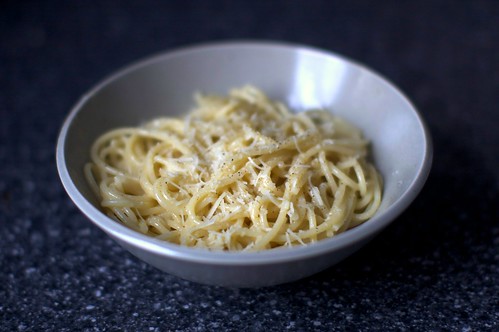
Spaghetti with Lemon and Olive Oil [Spaghetti al Limone]

From Smitten Kitchen (including notes before recipe)

 This is one of those recipes that are almost better off without one — every ingredient can be adjusted to taste and the technique is just tossing everything about. I consulted a bunch of recipes but ended up being lured in by Cook’s Illustrated’s January 2011 version, as it had so much less heavy cream and olive oil than the others and the threat of bathing suits was a mere 48 hours away! But, I ended up not using the recipe as more than an outline; I didn’t think shallots belonged in the dish, I wanted more lemon juice and I didn’t care for their resting technique — the cheese just glued itself to the pot and not the noodles when I did this — the “toss, toss, toss!” method I used in last year’s Cacio e Pepe does a better, quicker job.
  • 1 pound spaghetti or linguine
  • Salt
  • 3 lemons
  • 1/4 cup extra virgin olive oil , plus additional for serving
  • 1/4 cup heavy cream
  • 1 ounce finely grated Parmesan cheese (about 1/2 cup), plus additional for serving
  • Ground black pepper
  • Small handful fresh basil or arugula (what I used, deliciously, in a pinch) leaves, shredded
Cook linguine or spaghetti in well-salted water to your al dente tastes in a large, wide-bottomed pot. (You’ll have fewer dishes to wash if you use this pot to assemble the dish as well.)

While pasta is cooking, zest lemons until you have a little shy of a tablespoon of zest. Juice lemons — you’ll have anywhere from 1/3 to 1/2 cup lemon juice.

Drain pasta, reserving 1 1/2 cups of pasta cooking water. Dry out your pot, then boil the olive oil, cream, zest and 1 cup of the reserved pasta water together for two minutes over high heat. Return pasta to pot and stir until coated. Add the cheese and 1/4 cup lemon juice and toss, toss, toss everything together. Add more pasta water, 1/4 cup at a time, if you’d like your dish a little looser. Quickly taste a strand of pasta and see if you want to add the remaining lemon juice (we did). Stir in basil or arugula and season generously with salt and pepper.

Serve immediately, drizzling individual portions with a bit of extra olive oil and sprinkling with extra Parmesan cheese.

RESULTS:
Love love love. Definitely making this one again. It's nice and spring-y, which is a nice change from the spaghetti with cheese and black pepper that I love to make, but which is much more winter-y. Some nice green peas tossed in there wouldn't be amiss, I don't think, and it would add a little more color.

Wednesday, March 23, 2011

Penne with Roasted Red Pepper, Ricotta, and Sausage

One of my brother's former college roommates is a chef, and he's writing a cookbook. He asked for volunteers to help him test some of the recipes, and I volunteered, knowing it would be a challenge. It's not that the recipes are hard, it's that part of the deal is that you have to follow the recipes exactly to truly test them. I think we all know how hard this is for me. I mean, one of my favorite Christmas presents this year was the Food Substitutions Bible. Which I've already read. Cover to cover. Not much of a plot.

The first recipe that Matt gave me to test is the one posted here (don't worry, I made sure it was ok with him that I post it). This was a great first one for me because 1) I almost never cook with sausages, 2) I almost never cook with bell peppers, and 3) I almost never cook with ricotta. Although it was really hard to make sure to follow all the directions exactly, it was kind of fun that my input might make it into the finished product. By the way, for those of you in the D.C. area, Matt also teaches cooking lessons. He's got a fun blog, too.


This dish really highlights the flavors of Roasted Red Peppers in a pairing that just can’t be beat. The sausages can be hot or sweet depending on your preference, or if you want a slightly healthier version, you can always use slices of grilled chicken breast.

Yield: Serves 4-6

Ingredients:
6 oz         fresh ricotta
1 lb        penne pasta
2 Tbsp        vegetable oil
¾ lb        Italian sausage (sweet or hot) – removed from casings and crumbled
1 ea        onion – thinly sliced
2 ea        Roasted Red Peppers (page XX)
2 cloves    garlic
1 Tbsp        fresh flat-leaf parsley – chopped
2 Tbsp        fresh basil – chopped
¼ tsp        crushed red pepper
2 Tbsp        extra virgin olive oil
TT        salt and pepper
½ cup        Parmeggiano Reggiano – freshly grated
10 leaves    fresh sage – sliced thin
2 Tbsp        capers – drained and rinsed

Method:
  1. Spread ricotta on a double layer of paper towels.  Lay another 2 paper towels on top, and press down to remove excess moisture from the cheese. Change top towels a few times as needed to pull out excess water. Set aside.Bring a large pot of salted water to a boil over high heat.  Add the penne and cook until al dente.
  2. While pasta is cooking, heat a large sauté pan over medium-high heat. Add the vegetable oil, and then the crumbled sausage. Cook the sausage until done and remove to a paper towel-lined plate.
  3. Add the onions to the pan which the sausage cooked in, and cook quickly in the oil in the pan until softened. Set aside with the sausages.
  4. Place the roasted peppers, garlic, parsley, basil and crushed red pepper in a food processor. Pulse a few times, and then with the blades running, slowly add the extra virgin olive oil. Remove from food processor to a small bowl, and season to taste with salt and pepper.
  5. When the pasta is done, drain and return to the pot in which it cooked.  Stir in the ricotta, red pepper puree, sausages and onions and parmesan.
  6. Place in serving bowl or on individual plates and garnish with the sage and capers. Serve immediately.
 RESULTS: Very filling and very satisfying. It sort of socks you in the mouth with flavor. Just a note here: I initially didn't like the sage or the capers. And then they grew on me so much that for the leftovers (and there were lots, I think this made more like 8 servings rather than 4-6) I ended up adding MORE capers and MORE sage. So don't be afraid of the capers, but I think Matt said he might make them optional. Also, you might want to reserve some of the pasta water in case you pull out too much of the moisture from the ricotta (like I did).

Monday, November 22, 2010

For lunch yesterday I had sauteed onions, leftover roasted butternut squash, and salty sundried tomatoes tossed with penne pasta and a little of the pasta water (to pull it all together--you put the water and the cooked pasta into the pan that you're sauteeing the onions in. Also add the squash and tomatoes then to warm through, and toss until the water is mostly absorbed. I saw that on Emeril.). I topped that with some pungent blue cheese and slivered almonds. Really really good.

Sunday, October 10, 2010

Mushroom Lasagna

From Smitten Kitchen:

Serves 6 to 8 (more as a first course)
  • Salt
  • Olive oil
  • 3/4 pound dried lasagna noodles
  • 1 large clove garlic, minced
  • 4 cups whole milk
  • 3/4 cup (12 tablespoons or 1 1/2 sticks) unsalted butter, divided
  • 1/2 cup all-purpose flour
  • 1 teaspoon freshly ground black pepper
  • 1/3 teaspoon ground nutmeg (the recipe called for 1 tsp)
  • 1 1/2 pounds cremini or portobello mushrooms
  • 1 cup freshly grated parmesan
Preheat your oven to 375°F. Bring a large, wide (if you use a wide one, you can save a dish later and saute your mushrooms in the bottom of it) of water to boil with salt and a splash of oil, that will help keep your noodles from sticking together as they drain. Add the lasagna noodles and cook for 10 minutes. Drain and set aside.

Make béchamel: Bring the milk and garlic to simmer in a saucepan, or heat it in your microwave, and set it aside. Melt 1/2 cup (8 tablespoons or 1 stick) butter in a large saucepan. If your name is Deb, you will probably brown this butter, too. Add the flour and cook for one minute over low heat, stirring constantly with a whisk or wooden spoon. Pour in the hot milk, a little at a time at first and stirring until combined. Once you’ve added half of it, you can add the second half all at once, along with 1 1/2 teaspoons table salt, the pepper, and nutmeg. Cook over medium-low heat, stirring or whisking frequently, for 3 to 5 minutes, or until thick. Set aside.

Prepare mushrooms: Discard portobello mushroom stems and/or trim the ends of the cremini stems. Slice mushrooms 1/4-inch thick. Heat 2 tablespoons olive oil and 2 tablespoons butter over medium in the bottom of the large, wide pot you used to cook the noodles earlier, or in a large sauté pan. Cook the mushrooms with a couple pinches of salt for about 5 minutes, or until they are tender and release some of their juices, tossing to make sure they cook evenly. Repeat with additional oil and butter, and remaining mushrooms.

Assemble lasagna: Spread some of the sauce in the bottom of an 8 x 12 or 9 x 13 baking dish. (Ina recommends the former, I only had the latter; if you’d like to freeze or give this dish as a gift, remember to use a foil pan). Arrange a layer of noodles on top*, then more sauce (about 1/4 of what remains), 1/3 of the mushrooms and 1/4 cup grated parmesan. Repeat two more times then top with a final layer of noodles, your remaining sauce and last 1/4 cup of parmesan.

Bake for 45 minutes, or until top is browned and the sauce is bubbly. Let sit at room temperature for 15 minutes before serving. To freeze for future use, allow it to cool completely and wrap two to three times in plastic wrap before freezing.

RESULTS:
Holy nutmeg Batman! The recipe called for 1 tsp. I used 3/4 tsp, and it was a lot of nutmeg still. In the recipe above I reduced the amount. Otherwise this was very good. I would also recommend caution with cooking the mushroom. I overcooked them, so they released a LOT of their juices, and it left them a little dried out in the lasagna, but with a runny mushroom juice (I poured the juice in the final layer thinking the pasta would soak it up, but it didn't).

Sunday, May 23, 2010

Pasta Revelation

I can tell you without irony that this post will change your life (unless you don't eat pasta). I came across this examination of the techniques behind cooking pasta that doesn't require a rolling boil. I had my doubts, but tried it last night and it absolutely worked. I can't tell you how much of a pain it has been making pasta on an electric stove, because if I had the pasta on at high, it was really hard to get the other burners up to speed. No more!

Sunday, April 4, 2010

Classic Lasagne, Bolognese Style

From Mark Bittman's How to Cook Everything

Makes about 6 servings
Time: 45 minutes (with premade sauce)

  • At least 5 quarts water
  • 1 recipe Spinach Pasta or other fresh pasta or 12 dried lasagne noodles
  • 1 recipe Béchamel Sauce, about 1 1/2 cups
  • 3 cups, more or less, Meat Sauce, Bolognese-Style (Ragu)
  • 2 tablespoons softened butter or extra-virgin olive oil
  • 1 1/2 cups freshly grated Parmesan cheese
  • Freshly ground black pepper to taste
  • Salt, if needed
  1. Set at least 5 quarts water in a large pot over high heat. When it comes to a boil, salt it.
  2. Meanwhile, if you are using fresh pasta, roll it out. Cut to fit the dish.
  3. Cook the noodles a few at a time; keep them underdone (if they are fresh, this means little more than a minute in cooking time; for dried pasta, no more than a few minutes). Drain carefully in a colander, then allow to rest on towels while you prepare the béchamel sauce. Preheat oven to 400F
  4. Smear the bottom of your baking pan with the butter or oil, then place a layer of noodles, touching but not overlapping. Trim any overhanging edges. Cover the noodles with about one-quarter each of the béchamel, meat sauce, and Parmesan, then with a light sprinkling of black pepper (between the meat sauce and the Parmesan there should be enough salt, but if you feel it is under-seasoned, add a little salt to each layer also). Make four layers, ending with a sprinkling of Parmesan. (The dish can be prepared in advance up to this point, then well wrapped and refrigerated for a day or frozen for a month; defrost in the refrigerator for a day before cooking if possible.)
  5. Bake for about 20-30 minutes, until the lasagna is bubbly. Remove from the oven and let rest for 5 minutes before cutting and serving. Or let cool completely, cover well, and refrigerate for up to 2 days, or freeze for up to a month.
RESULTS: It's weird. I normally have trouble following recipes (as you may have noticed), and I thought for sure it would be worse cooking from a book like How to Cook Everything, which offers a handful of variations for just about every recipe. It's like it's not just giving me permission to improvise, but encouraging it. This cookbook is an enabler. The weird thing is, though, that I almost always follow his recipes to the letter. Even the cooking times, and it always turns out perfectly. The only thing I did differently with this was the ragu. I left out the onion, replaced the bacon with paprika, and accidentally forgot the milk. it still turned out great, but I did notice that it could have been more sauce-like. Anyway, Duane and Barry are here for Easter, and they loved it, and that's the important thing.

Originally I was thinking of making something like lamb or ham, but opted instead for the "traditional" Easter lasagna. A woman at my work is curing her own ham. It has to sit in a 5-gallon bucket for a week covered in curing spices. She said if she's not in work tomorrow, then we'll know how it turned out. After hearing that, the lasagna seemed safer.

Saturday, February 13, 2010

Spaghetti with cheese and black pepper (or Spaghetti cacio e pepe if you want to sound impressive)


Bethie sent this to me from Smitten Kitten:

Adapted very loosely from Mario Batali

As I’ve mentioned, for something with such a simple ingredient list this dish manages to fall all over the map. Some versions use just oil, no butter, some use neither oil of butter; some stud the sauce with large, barely cracked peppercorns and half-melted pebbles of romano; some opt for a smoother cheese, cacio de roma, which I located, auditioned and discovered I liked the saltier and more accessible Pecorino Romano better. There are a lot of ways to approach the dish and people who will find something inauthentic with each of them. I say ignore them all and just enjoy your spaghetti.

Serves 4 as a main, 8 as a first course

1/4 cup olive oil
1 pound dried spaghetti
2 tablespoons butter
4 ounces Pecorino Romano cheese, finely grated
1 1/2 teaspoon finely ground black pepper
Salt (optional)

Cook spaghetti in well-salted water to your al dente tastes in a large, wide-bottomed pot. (You’ll have fewer dishes to wash if you use this pot to assemble the dish as well.) Drain spaghetti, reserving 1 1/2 cups of pasta cooking water.

Dry out your pot, then heat the olive oil over high heat until almost smoking. Add drained spaghetti and 1 cup of reserved pasta water and jump back, this will splatter mightily, also known as “I made this three times, and never once learned my lesson. Do as I say, not as I do.”

Add butter, 3 ounces cheese and ground pepper and toss together with tongs. Taste, adding more pasta water, cheese, pepper or salt (which should not be neccessary, as Romano is very salty) to taste.

Serve immediately, sprinkling with reserved cheese and an extra grind or two of black pepper.

RESULTS: This was really easy and the taste, proportionally, was way impressive for the work put into it. Chris had concerns about the pouring spaghetti and water into hot oil thing, but I was using our really tall spaghetti pot and I had the lid on hand to slap over the top immediately and minimize disaster.

When I read the recipe, I was thinking, what's the big difference between this and just putting butter and cheese over spaghetti our your plate? I think the pasta water makes all the difference. It comes out looking and tasting like a less-heavy cheesy alfredo sauce. We were in a hurry to eat, so I didn't make any vegetables or meat to go with this, but I think you really need it. It's just a little too plain to eat as an entire meal, but it would be delightful as a side to sauteed mushrooms or some fish or chicken. (So says me. Chris, who happily makes himself pasta and butter for dinner each and every time I don't cooks something believes it wasn't plain at all.)

Thursday, January 14, 2010

Penne With a Mushroom Ragu

This one goes out to Kathleen, who is having mushrooms this weekend (just in case you don't already have a recipe picked out). From the Washington Post,

Summary:

Here, a few easily found ingredients make a dish loaded with flavor: Assorted mushrooms (you can buy them pre-sliced to save time) are sauteed with just enough fat to help them cook, then infused with wine to make a vegetarian ragu. Chopped parsley is needed to add that little bite right at the end. Toss the sauce with pasta, and serve with a salad.

4 servings

Ingredients:

* • 1 tablespoon unsalted butter
* • 1 tablespoon olive oil
* • 1 small (2 ounces) onion, cut into thin slices
* • 1 pound assorted mushrooms, rinsed, stemmed if desired and cut into thin slices (I used baby portabellas and crimini)
* • 1/4 teaspoon salt, or more to taste
* • 8 ounces dried penne or gemelli pasta
* • 3/4 cup dry white wine (I used chardonnay)
* • Leaves from 2 to 4 stems curly or flat-leaf parsley, finely chopped (1/4 cup)
* • Freshly ground black pepper
* • Freshly grated Parmesan cheese, for serving (optional)

Directions:

Heat the butter and oil in a large skillet over medium-high heat. When the butter has melted, add the onion and cook for about 4 minutes, stirring occasionally, until it has softened. Add the mushrooms and 1/4 teaspoon of the salt; mix to incorporate, then cook for 8 to 10 minutes, stirring occasionally, until the mushrooms' moisture has been released and evaporated and the mushrooms are just beginning to brown.

Meanwhile, cook the pasta according to the package directions. Drain.

Reduce the heat under the mushrooms to medium, then add the wine and mix well. Cook for about 3 minutes or until the liquid in the skillet has reduced by half. Remove from the heat.

Add the parsley and freshly ground pepper to taste. Taste, and add salt as needed.

Add the drained pasta to the ragu; toss to combine. Serve hot; pass the Parmesan cheese at the table, if desired.

Results:
I think an easy place to go wrong is not to cook the mushroom all the way. I like my mushroom with some good browning. It'll take some experimentation with temperature to get them browned without burnt. Otherwise, I really liked this dish. Don't skimp on the salt or pepper! I'm sure the ragu would live just as happily over rice or meat.

Sunday, August 9, 2009

Zucchini in pasta sauce

I've been hearing that you can put zucchini in a pasta sauce and you'll never know it's there. It's true! Even Chris grudgingly admitted that he liked it. I shredded a zucchini on my box grater and sauteed the shreds with the salt, pepper, olive oil, and garlic that I was going to use to make the sauce anyway. (Next time I think I'll salt the shreds and let them drain in a collider for a while first, just to see what happens.) I meant to saute it until brown, but the zucchini actually just sort of built up a layer of browned mush on the bottom of the pan and I didn't want that to burn so I just aborted that plan (any ideas for how to avoid the layer of mush?). I deglazed the tasty brown mush with tomato juice from the can of diced tomatoes I was going to put in the sauce, then added everything else. Browned zucchini sort of gets that savory flavor that I'm pretty addicted to this time of year, and it added a subtle smokeyness to the sauce.

Monday, February 2, 2009

Baked Penne with Smoked Paprika

I decided to go ahead and try a baked pasta dish (baked penne) with the smoked paprika that Dave and Kathy brought back for us from Spain (aka, Chris's Favorite Spice) and it turned out really well. I just kept adding a little to the sauce until it tasted right, maybe about half a teaspoon? I would recommend, though, that if you try this you should get good smoked paprika, not mediocre sweet paprika, because the smokiness was really what did it for us. We couldn't tell if we were tasting the paprika or smelling it, but either way, delish. It's a nice variety.

Sunday, September 7, 2008

Fancy-Pants Macaroni and Cheese

Three Cheese Macaroni and Cheese:
From Cooking Light Magazine

1 teaspoon olive oil
1 cup finely chopped onion (about 1 medium)
2 tablespoons all-purpose flour
1 garlic clove, minced
1 1/2 cups 1% low-fat milk
1 bay leaf
1/2 cup (2 ounces) crumbled Gorgonzola cheese
3/4 cup (3 ounces) grated Parmigiano-Reggiano cheese, divided
1/4 teaspoon salt
2 cups uncooked elbow macaroni (about 8 ounces)
Cooking spray
2/3 cup (about 2 1/2 ounces) shredded part-skim mozzarella cheese
2/3 cup panko (Japanese breadcrumbs)
1/8 teaspoon freshly ground black pepper

1. Heat oil in a medium saucepan over medium heat. Add onion to pan; cook 8 minutes or until tender, stirring occasionally. Add flour and garlic; cook 1 minute, stirring constantly. Stir in milk and bay leaf; bring to a boil. Cook 2 minutes or until thick, stirring constantly with a whisk. Add Gorgonzola, 1/2 cup Parmigiano-Reggiano, and salt; stir until cheeses melt. Discard bay leaf.

2. Preheat oven to 375°.

3. Cook pasta in boiling water 5 minutes or until almost tender, omitting salt and fat; drain well. Add pasta to cheese mixture, stirring well. Place about 1/2 cup pasta mixture into each of 6 (1-cup) ramekins coated with cooking spray. Sprinkle evenly with mozzarella. Top evenly with remaining pasta mixture. Combine remaining 1/4 cup Parmigiano-Reggiano and panko; sprinkle evenly over pasta mixture. Spray lightly with cooking spray; sprinkle with black pepper. Bake at 375° for 25 minutes or until heated.


Yield: 6 servings (serving size: about 1 ramekin)

RESULTS: Chris wasn't too thrilled about the onions, to put it mildly, and I have to say, really not as good as the much easier version that's in my Spoon cookbook (although they of course call it Macaroni Au Gratin, because it's Italian). I'm posting that recipe below. One thing I was sort of shocked at is that the Spoon version might be healthier, or at least almost as good, as the Cooking Light. There's more butter in the Spoon one, but much much less cheese, especially considering CL calls for 2 cups of pasta and Spoon calls for 3 cups (meaning, the pasta:cheese ratio is higher for The Spoon, but it tastes better). I've even cut the butter from the Spoon version to little or no taste difference, and sometimes I leave in the egg yolks, but generally I'll take them out. I'll give you the cookbook version, and then my edits in parenthesis. It starts with a basic bechamel sauce and then you add the cheese and pasta.

Bechamel Sauce

Ingredients:
1/4 c butter (I want to try this with a combo of butter and oil, either canola or olive, but haven't gotten around to it yet. It's important in a bechamel sauce for the fat and the flour to be the same amount. Thickness is altered by changing the amount of milk/water/cream)
1/4 c all purpose flour
2 1/4 c milk
pinch of freshly grated nutmeg (optional)
salt and pepper


Melt the butter in a pan over medium heat. Whisk in the flour. Pour in all the milk, whisking constantly until it starts to boil. Season with sale, lower the heat, cover and simmer gently, stirring occasionally, for at least 20 minutes. The sauce should not taste floury (which is why you simmer for so long). Remove from heat and season with salt if necessary, pepper, and/or nutmeg. If sauce is too thick, add a little more milk. If too runny, add a pat of butter mixed with an equal amount of flour. For a lighter bechamel sauce, replace some of the milk with water.


Macaroni Au Gratin


Ingredients
2 Tbls butter, plus extra for greasing (I do grease the pan with butter or olive oil, but I tend to leave out the 2 Tbls)
Bechamel sauce made above
2/3 cup cheese (the cookbook recommends Parmesan, but whatever you want)
2 egg yolks (I tend to leave these out)
3 cups macaroni
salt

Preheat oven to 475 degrees. Grease an ovenproof dish with butter (the top of the dish gets really nice and lovely brown, and it tastes really good, so I try to go with the widest pan possible). Combine the bechamel sauce, cheese, butter and egg yolks. Boil pasta until just al dente, then drain and tip into a bowl. Gently stir in half of the bechamel sauce mixture and put in the prepared dish, then spoon the remaining bechamel sauce mixture on top. Bake for 15-20 minutes until golden brown.

RESULTS: This may be one of my favorite dishes, it's very delicious. Chris likes it too, and it has no onions.

Thursday, June 26, 2008

pasta with raw tomato sauce

It was about 95 degrees and humid as anything today, so the idea of turning on the stove or oven was unappealing to say the least. This recipe is from The Spoon and uses two of the things I have in abundance this week: tomatoes and basil.

Combine in a bowl and let rest in a cool place to allow the flavors to mingle for 30 minutes:
1 lb 2 oz tomatoes, peeled, seeded and chopped*
4 Tbls olive oil
10 leaves of fresh basil, chopped
2 cloves of garlic
salt and pepper

Remove the garlic and discard. Mix in 1 lb of pasta (use the kind with ridges, like penne or spaghetti rigatoni) and serve with Parmesan.

* to prepare the tomatoes, I put them in a pot of boiling water for 1 minute, then lifted them right out with tongs and put them in a bowl of ice water. The skin comes off very easily. I cut them in half and squeezed over the sink to get out the seeds, then chopped.

RESULTS: Not the BEST tomato sauce I ever had, but it wasn't hot, and the kitchen wasn't hot, and there was very little clean up, so the ratio of healthfulness and taste to effort and inconvenience was reasonable. It just wasn't busting with flavor, although you could really taste the basil (and I liked being able to use my own), so I wouldn't make this with dried basil since that's so important in this dish. I only used one garlic clove, since my notes in the cookbook from when I made it last summer said "go easy on the garlic," but maybe it needs that second clove. I kept adding more and more pepper to try to get more flavor in it. But, like I said, it was cool on a hot day.

On another note, Harper came outside with me when I harvested the basil, and she caught the hugest cicada I have ever seen. It must have been a two-pounder. I was in Japan that summer that the cicadas took over so I didn't really get the cicada experience that everyone else did, but I can't even begin to imagine millions of those things. Maybe they were smaller since there were so many. I mean, this thing was HUGE. I halfway tried to get her to drop it, but frankly, I was sort of glad she was doing away with it before it decided it liked the looks of my herbs because they would be DONE for.

Sunday, June 15, 2008

Penne with Roasted Tomatoes and Garlic

3 large tomatoes, cut into wedges (about 2 lbs)
4 cloves garlic, unpeeled
2 tablespoons olive oil
1/4 teaspoon salt
Freshly ground black pepper
1(15 ounce) can cannellini beans
1/2 pound penne pasta
1/4 cup fresh basil leaves, torn
2 tablespoons freshly grated Parmesan


Preheat the oven to 450 degrees F.
Slice each tomato into 8 wedges and discard the seeds. Put the tomato wedges and garlic into a 9 by 13-inch roasting pan. Drizzle with 1 tablespoon of olive oil and sprinkle with salt and a few turns of pepper. Roast in the oven, uncovered, for 40 minutes.

Drain the beans into a large colander in the sink. Cook the pasta according to the directions on the package. Drain the pasta into the colander containing the beans, so the hot pasta water will warm the beans. Return drained pasta and beans to the pasta pot.

When the tomatoes are done, pick out the garlic cloves, squeeze the garlic out of the skin into a small bowl and mash with a fork. Pour the roasted tomatoes into the pasta pot, add the garlic, the remaining 1 tablespoon of olive oil, the basil and additional salt and pepper, to taste. Toss to combine. Serve topped with the Parmesan.


RESULTS: I'm definitely making this again, especially with tomato season just starting. The tomatoes got very sweet, like sun dried tomatoes, and it was really great with the basil. The garlic was very mild. Next time, I might try roasting the tomatoes with artichoke hearts, too, to see what happens.

When I pulled the tomatoes out of the oven, the roasting pan was a mess. A lot of the tomatoes had carmelized to the bottom of the pan. The pasta and beans were looking a little dry, (I didn't use enough tomatoes) so I thought I'd just deglazed the roasting pan with water and use that to moisten the pasta. That was ok, but I think even better would have been to use a little dollop of tomato paste along with the water, or maybe save some of the pasta water and use that. I just think I can definitely do better for sauce than just water.

Wednesday, April 23, 2008

Penne Arrabiata

I had a slight crisis on Monday evening when we discovered that we had used our last can of diced tomatoes. I have suffered endless ridicule and derision over the last year because someone has felt that my stockpiling of canned tomato products is a bit too Montana and asked that I not buy any more, no matter how good the sale is, until I used up all the cans I already bought. Well, we were making a pizza on Monday and I was just going to put diced tomatoes on top with some spices and cheese, and I ended up having to use, of all things, pizza sauce. This can of sauce has been with us for a while, we must have bought it our first year in Madison, so I think we can all agree that the diced toms would have been better. Anyway, without my handy diced tomatoes (I do my shopping on the weekend, I’m just too tired after work), I’ve had to think creatively. Last night, I foraged for nuts and berries (remind me to tell you about these nuts, if I get the recipe!). Tonight, I’m frying up some polenta. Should be interesting.

What do I use my diced tomatoes for? Pretty much everything. I don't think I've posted this recipe, for Penne Arrabiata from The Spoon, but it's probably my favorite sauce at the moment, despite a disastrously huge amount of red pepper flakes when I made it for my family. The amounts are all totally flexible.

Heat up a skillet on low (this is not flexible). When it's warm, add, oh, about 6 Tbls or so of olive oil, a whole clove of garlic (or, if you like it garlicky, add more cloves or mince the one you add) and a dash of red pepper flakes. Don't let either of these burn, or you'll have to start over. Believe me. You might raise the heat a little if you need too. If you have fresh parsley, toss that in. If not, dried is ok. Cook all this, stirring, for a few minutes until the garlic is light brown, and then turn the heat back down and CAREFULLY add two cans of drained petite diced tomatoes, preferrably the no salt added kind. Add a generous sprinkle of salt to taste (confusing, I know, but it's better if you add the salt). If you add the tomatoes when the pan is too hot, the moisture on them will fight with the hot oil, and you'll have burned tomatoes and oil flying all over the place. The salt will break down the cell walls of the tomatoes, so even though they start out whole and not sauce-like, it'll end up really saucey. Give it about 15 minutes. If you left the garlic whole, take that out, and then serve with penne and cheese, if you like.

Wednesday, April 9, 2008

Baked Shells with Winter Squash

I decided to toss out the spicy black bean cakes recipe. If I'm going to go through all that for a black bean recipe, I might as well just make black beans and rice. So, here's another from Martha Stewart.

Ingredients

Serves 6.

  • Butter, for baking dish
  • 4 tablespoons olive oil
  • 2 large onions, halved and thinly sliced
  • Coarse salt and ground pepper
  • 2 teaspoons chopped fresh rosemary leaves
  • 1 pound small pasta shells
  • 1 package (12 ounces) frozen winter squash puree, thawed
  • 1 cup grated Parmesan cheese
  • 3 slices crusty baguette, cut into 1/4-inch cubes (1 1/2 cups)

Directions

  1. Preheat oven to 400 degrees. Butter a 9-by-13-inch baking dish. Heat 3 tablespoons oil in a large skillet over medium-low heat. Add onions; season with salt and pepper. Cover; cook until onions are soft and release liquid, 15 minutes. Uncover; raise heat to medium. Cook, stirring, until onions are browned, 20 to 25 minutes. Stir in 1 teaspoon rosemary.
  2. Meanwhile, cook pasta in large pot of boiling salted water 2 minutes less than package instructions suggest. Drain, reserving 1 1/2 cups cooking water. Return pasta to pot.
  3. Stir squash and reserved pasta water into onions; simmer 2 minutes. Toss squash mixture and 1/2 cup Parmesan with pasta. Transfer to prepared dish.
  4. Combine bread cubes with remaining Parmesan, rosemary, and oil; season with salt and pepper. Top pasta with bread cubes; bake until golden brown, 10 to 15 minutes.

RESULTS: I really liked this one, and Chris didn't hate it. The onions get nice and sweet (I only used 1/4 of one white onion. I think you can adjust it to taste) and it's the same color as Kraft mac and cheese, but without all the powdery guilt. :) The best part was definitely the bread cubes on top, especially since I defrosted some of the homemade bread and used that. I might try those bread cubes on other casserole-type dishes. Wait till the bread gets nice and brown.

Sunday, April 6, 2008

artichokes with penne

I mentioned before that I got interested again in cooking when brother Chris gave me a honkin' huge traditional Italian cookbook for Christmas a couple year ago. Some of the recipes are not something I'd like to attempt, things with squid ink and intesines, etc. Other recipes are really easy and have about 2 ingredients. One of husband Chris and my favorites is a sauteed artichoke dish with penne. I like how with dishes prepared in a saute pan, you can take liberties with the recipe more easily than in a baking dish that gets put in the oven and is not to be disturbed for hours and hours, and I definitely did that with this recipe. It calls for things like fresh artichokes, and it says how to cook them and whatnot, but there won't be good fresh artichokes for a while, so I just use canned. It's so easy, I can tell you what I did tonight without looking at the recipe.


heat some olive oil (3-5 Tbls, ish) in a large saute pan over low heat. Toss in a whole garlic clove, some parsley and a dash of red pepper flakes and saute until the garlic is lightly toasted, or however you like it. TOSS THE GARLIC (there's going to be some major heat in a second, and the garlic will burn and smell awful if you leave it in). Finely chop a couple cans of non-marinated artichoke hearts. Throw those in the saute pan and raise the heat to medium. Give it a good stir, and then let it simmer away in it's juice. Eventually, that juice is going to evaporate. What I like to do then, if there's time, is let the artichokes get nice and brown. This adds an amazing flavor that the steamed/stewed artichokes (what was going on as the water was evaporating) just doesn't have. My pan usually gets pretty dry, and even on our non-stick saute pan you get little bits stuck to the bottom. That's ok. Keep stirring occasionally to move more artichokes in contact with the pan. When it gets to the doneness that you like it (the browner the better, I say), use a little of the pasta water from your penne to de-glaze the pan. Maybe you could also use white wine(?) I don't know how white wine goes with artichokes, but you DEFINITELY do NOT want to use red wine. That would be awful.

Tonight, I let the artichokes get browner than usual, to the point of crispness, and I added the red pepper flakes, which I never did before, and both were good additions. The recipe calls for fresh parsley, but I won't have any of that for a few weeks, so I always use dried.

serve with the penne, and it you want, either parm. or mozz. cheese. Or, you can not serve it with pasta, but put the artichokes in a baking dosh, top with cheese and bake until melty, then serve with slices of bread. Delicious!

Tuesday, April 1, 2008

Whole Wheat Tagliolini with Fresh Cherry Tomato Sauce

From Cooking Light Magazine:

The nutty, slightly sweet flavor of whole wheat flour is a tasty addition to a basic pasta recipe. Look for the smallest sweet tomatoes you can find for this simple sauce. Substitute grated orange rind for the lemon, if you prefer.

Ingredients
Pasta:
  • 1 cup all-purpose flour (about 4 1/2 ounces)
  • 1 cup whole wheat flour (about 4 3/4 ounces)
  • 1 tablespoon plus 1/4 teaspoon salt
  • 5 tablespoons water
  • 2 tablespoons extravirgin olive oil
  • 2 large eggs object
  • 6 quarts water

Sauce:

  • 2 tablespoons olive oil
  • 2 garlic cloves, minced
  • 5 cups quartered cherry tomatoes
  • 1/2 cup thinly sliced fresh basil
  • 3 tablespoons drained capers
  • 1 teaspoon grated lemon rind
  • 1/4 teaspoon crushed red pepper
Preparation:

1. To prepare pasta, lightly spoon flours into dry measuring cups; level with a knife. Combine flours and 1/4 teaspoon salt in a food processor; process 30 seconds. Combine 5 tablespoons water, 2 tablespoons olive oil, and eggs in a bowl, stirring well with a whisk. With processor running, pour water mixture through the food chute, processing just until dough forms a ball. Turn dough out onto a lightly floured surface; knead 5 or 6 times. Shape dough into a disk. Dust dough lightly with flour; wrap in plastic wrap. Let stand 30 minutes.

2. Divide dough into 3 equal portions. Working with 1 portion at a time (cover remaining dough to prevent drying), press dough into a flat rectangle. Roll the dough into a 14 x 14–inch square, dusting with flour, if necessary (turning dough over occasionally and dusting surface with flour as needed). Lay dough sheet flat; fold ends so they meet in the middle. Fold the sheet in half like closing a book. Fold in half again to form 8 layers of pasta. Using a sharp knife, cut the pasta crosswise into 1/4-inch-wide noodles. Separate noodles, and dust with flour. Place noodles on a jelly-roll pan dusted with flour. Repeat procedure with remaining dough portions.

3. Bring 6 quarts water and remaining 1 tablespoon salt to a boil in a large Dutch oven. Place noodles in a sieve; shake off excess flour. Add noodles to pan. Cook 1 1/2 minutes or until done; drain.

4. To prepare sauce, heat 2 tablespoons oil in a large nonstick skillet over medium-low heat. Add garlic to pan; cook 3 minutes, stirring frequently (do not brown). Remove from heat. Stir in tomatoes and remaining ingredients. Toss with noodles.

Yield
4 servings (serving size: 1 1/4 cups)

RESULTS: Meh. I didn't use enough flour at first and the pasta just sort of squashed into a glob instead of separating into ribbons. I didn't try the sauce, but I'm including it in case you'd like to. Maybe I'm just not a fresh pasta gal? Elsewhere in this article in this month's cooking light (March, or maybe April) there was a recipe for ravioli. That I'd like to try. The food network and other cookbooks keep trying to push the wonton wrapper ravioli, and I've tried it and it's not good. They get all slimey and you can see through them, sort of like, I don't know, rice paper or something not ravioli-ish. I think the wonton wrapper lobbyists have a hand in this sudden popularity. Anyway, I don't dig it, but I'd like to try rolling my own ravioli pasta. For this pasta, the rolling was acutally way easy, I really don't think you'd need a pasta roller or anything. We'll see.

Saturday, March 22, 2008

Alfredo Sauce variation


Alfredo Sauce (with fettuccine) from Cookinglight.com: "We used half-and-half instead of whipping cream and decreased the amount of butter and cheese ever so slightly to lower the fat by about 10 grams per serving."

1 pound uncooked fettuccine
1 tablespoon butter
1 1/4 cups half-and-half
3/4 cup (3 ounces) grated fresh Parmesan cheese
1/2 teaspoon salt
1/4 teaspoon black pepper

Melt butter in a large skillet over medium heat.

Add half-and-half, cheese, salt, and pepper; cook 1 minute, stirring constantly. Reduce heat; add pasta, tossing gently to coat. Cook pasta according to package directions, omitting salt and fat.


RESULTS: I'm including this mostly for comparison's sake to the other alfredo recipe below, which was delish, but way rich. This recipe was just awful, and looked nothing like the photo online. Either the half-and-half separated or the parm cheese never melted, but it was as lumpy as if I had added scrambled eggs. Even if it hadn't been lumpy, it didn't taste anything remote close to an improvement over pasta with butter and cheese, which is sort of my standard. If it's a pasta dish, the nutrition or taste improvement over pasta with butter has to be significant enough to counteract the work that went into preparing it, and this definitely did not. Plus, we know from experience that creamy sauces don't reheat well at all, so I couldn't even save the leftovers! Not that we wanted it again.

Herb update: The mint is completely out of control already. I'm glad I knew this about mint beforehard, because otherwise I might have been afraid it would start calling me Seymour, asking for me to feed it. It has literally and at least DOUBLED in height in two weeks.

On the tamer side, the parsley has just exploded upwards. It's definitely taller than the basil, which seems to have decided to take a break from growing up to work on leaf growth, which is great because I can't transplant it to it's permanent home until the first set of true leaves come in. Exciting stuff!

Tuesday, March 4, 2008

Fettuccine Alfredo

This weekend was very lamb-y, but today was nothing if not lionish, (although I DID have my first flower spotting of the season, a whole mess of snow drops and some flowers that were tiny yellow fuzzy balls. I have no idea what they were, but my neighbor had a slew of them) so I thought what better for dinner than fettuccine alfredo. Bethie, and other poor lactose intolerant souls, this is not for you. I got the recipe from wikipedia, of all places, but that also means I can just copy and paste the recipe below (ignore the links in the ingredient list):

The tricks to making a good Alfredo are gentle cooking and a proper balance of ingredients. The sauce should be just thick enough to coat the pasta without pooling on the bottom of the plate, but it should not be so thick as to be glue-like. The sauce can be made in the time that it takes to bring a pot of water to the boil and cook the pasta.

Fettuccine Alfredo should be served immediately, because as it cools the large amount of fat in the sauce will congeal too much. If it cannot be served immediately it should be made thinner in the pan than you want it when it's plated and presented.

This recipe will sauce one pound of pasta and serves 6 as a first course.

Ingredients

Preparation

  1. Combine 1¼ cups (300ml) cream and the butter in a saute pan large enough to accommodate the sauce and later the pound of pasta. Heat over a low flame, stirring frequently, until the butter is melted and the cream comes to a bare simmer. Remove the pan from the heat once the butter is evenly incorporated into the cream.
  2. Cook the pasta, draining it a little before it reaches the al dente stage. The pasta should be slightly undercooked before being added to the sauce because it will continue to cook while the sauce is being finished.
  3. Drain the pasta and add it to the pan, along with the remaining ½ cup (100ml) of cream, the cheese, the salt, the nutmeg, and several grinds of the pepper mill.
  4. Heat the pasta and sauce over a low flame, tossing continuously, until the cheese melts into the sauce and the sauce thickens slightly, about 1 - 2 minutes.


Results: Wow. That's a lot of cream and cheese. Even more cheese than my macaroni au gratin, which I will post the next time I make it. I think it was, if you can believe it, too creamy. Maybe it would benefit by having some of the cream replaced by normal milk? I don't know how that would affect the end results. Also, I didn't use NEARLY that much cheese, maybe more like 2/3 of a can of grated parm (6 oz) instead of 1+ cans. Finally, I decided it was still missing something, and it wasn't more cheese. It needed a little....kick. I decided the whole thing was drastically improved by a little sprinkle of Old Bay. BAM! Even Alton Brown of Good Eats fame says it's his favorite spice. Now that's something.

Casualties: possibly a few arteries. Will let you know later.